Zygomatic implants when the jawbone is not enough.
An option, in selected cases, for patients who have lost bone in the upper jaw. Planned on CT and performed as a team, with the possibility of fixed teeth within 12 hours when the case allows.
A long implant anchored in the cheekbone.
A zygomatic implant is anchored in the zygomatic bone, not only in the bone of the jaw ridge, so it can be considered when the upper jaw has lost volume.
Anchored in the zygomatic bone
A region of bone that is often preserved even when the jaw ridge has atrophied.
An alternative to grafting, in selected cases
In many cases it avoids the need for a bone graft. Not every case qualifies: the decision follows the CT scan.
Immediate loading
Immediate loading is our specialty: when the case allows it, the implants are placed in the morning and you leave the same day with fixed teeth, within 12 hours.
Not the first choice. The right choice for some cases.
May be considered
Upper jaw with significant bone loss. When bone grafting is not desired or not indicated. In full-arch rehabilitation of the upper jaw.
May not be needed
When there is enough bone for conventional implants, which remain the first option.
From first contact to fixed teeth.
Remote review
You send what you have: photos, a panoramic X-ray or a description. I tell you whether a CT scan is needed.
CT scan and digital planning
The CT shows the available bone and lets us plan the implant positions on the computer before surgery.
Surgery in a surgical center
Local anesthesia, with a cardiac monitor, pulse oximetry and an AED available. The team operates together.
Fixed teeth and follow-up
When the case allows it, fixed teeth are placed the same day, within 12 hours. The final prosthesis follows after healing, with follow-up.
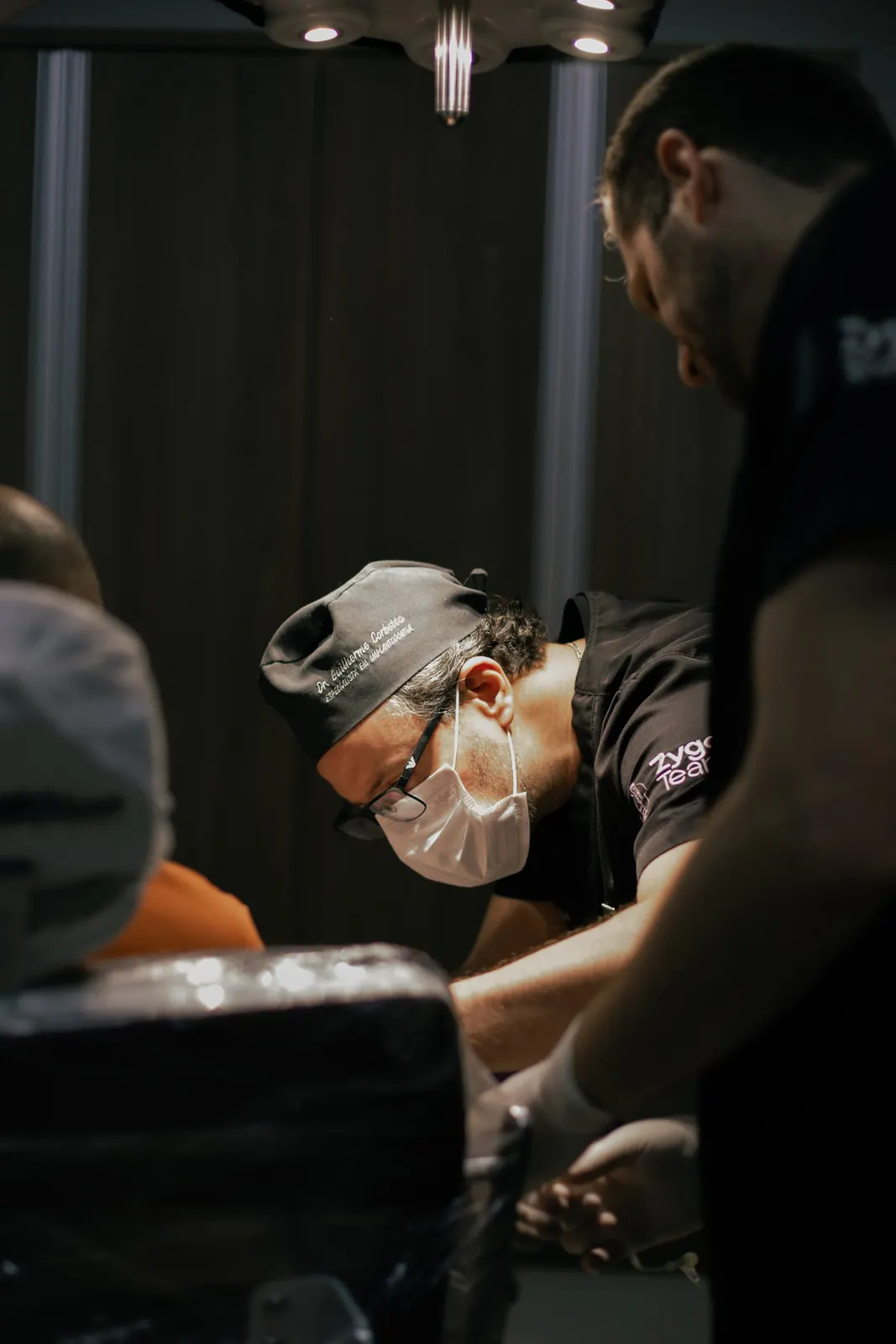
Surgery done as a team, with the Zygo Team.
The 500+ cases belong to the Zygo Team, combined across the three surgeons, not to a single practitioner. Meet the team.
Common questions about zygomatic implants.
What are zygomatic implants?
Long implants anchored in the zygomatic bone (the cheekbone) instead of relying only on the bone of the upper jaw ridge. They can be a solution for people who have been told they don't have enough bone for implants and want fixed teeth, often without the need for a bone graft. They depend on a CT scan and an in-person assessment. Learn more about zygomatic implants.
Are zygomatic implants an option if I was told I don't have enough bone?
In selected cases, yes. Zygomatic implants may be considered when the upper jaw has lost too much bone for conventional implants, but they are not the first choice and they need imaging and an in-person assessment before any decision.
Can I leave surgery with fixed teeth?
Often, yes. Immediate loading is our specialty: when the case allows it, the implants are placed in the morning and you leave the same day with fixed teeth, within 12 hours. Not every case allows it, but today this is quite predictable thanks to the CT imaging we use, which shows beforehand whether your case is a good fit.
What about anesthesia? Is the surgery safe?
Surgery is performed under local anesthesia. Depending on your health, I may ask for a clinical evaluation and surgical risk clearance from your cardiologist or physician, to define what is needed beforehand. The procedure takes place in a surgical center with a cardiac monitor, oxygen saturation monitoring (pulse oximetry) and an AED available.
Does it hurt? What is recovery like?
During surgery, local anesthesia blocks pain. Afterwards, the prescribed medication keeps discomfort under control; even so, some discomfort and swelling may be felt in the first days, and they tend to ease as the days go by. You will receive instructions on care and on returning to your routine.
How much does treatment cost?
The cost can only be set after the clinical and radiological evaluation of your case, because it depends on how many implants are needed, the complexity and the prostheses. That is why the estimate is individual and there is no fixed price in advance.
Want to know if your case is a candidate?
Send a short message and I will reply personally. You do not need exams to start.